In Pakistan’s merged districts, conversations around women’s inheritance rights are often silenced by tradition, fear, and lack of access to information. For Jamaima Afridi, a freelance journalist and documentary filmmaker from the Khyber Agency, breaking that silence is not just professional work, it is a responsibility.
An alumna of the English Access Program (2013), Jamaima used her PUAN Alumni Small Grants project to shine a light on an issue many women quietly endure: being denied their legal and religious right to inheritance. Through a carefully crafted documentary and a series of community screenings, her project created space for learning, dialogue, and action in areas where such discussions are rare.
Turning the Camera Toward Justice
Jamaima’s documentary focused on real stories from marginal areas, women who had successfully claimed their inheritance, those still struggling to do so, and experts who could explain both the legal process and Islamic teachings related to inheritance. A lawyer outlined the practical steps women can take to pursue their rights, while a religious scholar clarified misconceptions often used to deny women their share.
Once completed, the film was screened at multiple locations:
- A university in the former FATA region, attended by over 100 students
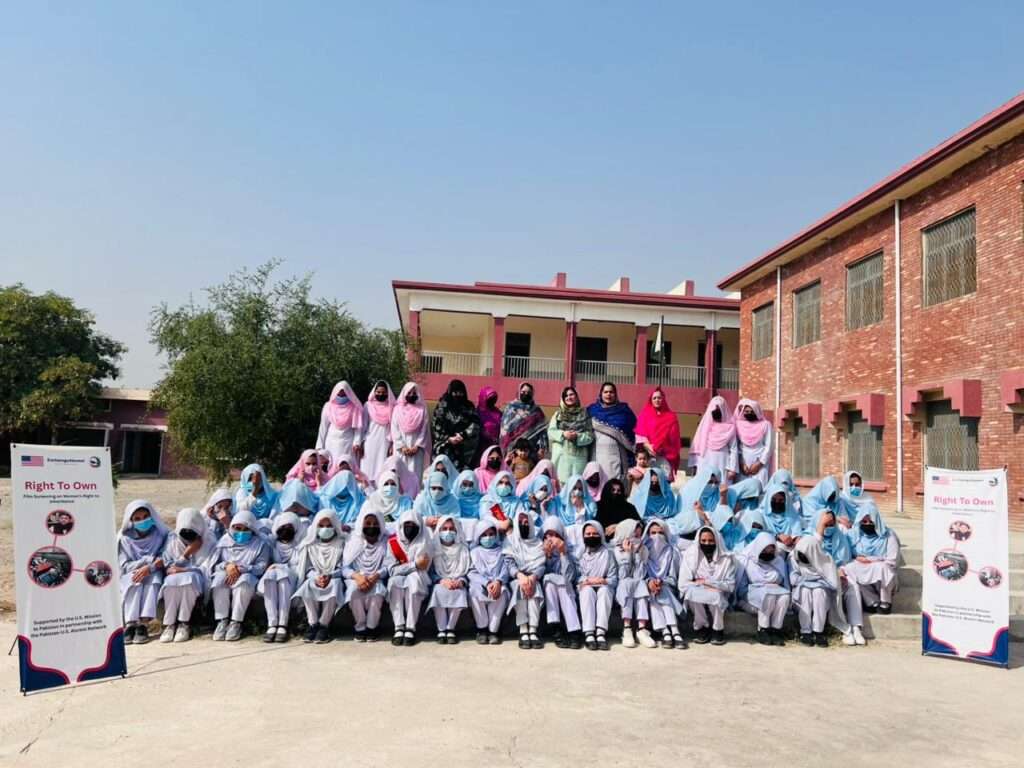
- A girls’ college in Mohmand, with more than 60 participants
- A community screening in Landikotal, where local women gathered to watch and discuss the film
Across 24 weeks, the project directly engaged 200 people, most of them women, while reaching over 1,500 indirect beneficiaries through wider sharing and discussion.
From Awareness to Action
The most powerful outcome of the project was not just awareness, but change. One woman featured in the documentary, who had long struggled to claim her inheritance, is now actively pursuing a legal case.
“After I gave an interview and talked about my issue, I realized it was high time to demand my inheritance rights, not just for myself, but for my sisters who are struggling because they have nothing,” she shared. “I also learned how to file a case with the help of the ombudsperson, because I cannot afford legal expenses.”
For young participants, the screenings offered clarity and motivation.
“We come from an area where many people are unaware of these issues,” said Zain Afridi, 24, from FATA University. “The most valuable part was the legal perspective on how women can claim their inheritance rights. Hearing from a lawyer who had claimed her own inheritance was especially inspiring.”
Educators also saw the value in starting these conversations early.
Mahrukh Mohmand, Principal of a girls’ college in Mohmand, noted that the screening was crucial in helping students understand their rights and the paths available to them.
Watch the documentary here:
Adapting in Challenging Circumstances
Implementing the project was not without challenges. Due to security concerns and conflict in certain areas, Jamaima had to pause activities and change locations mid-project. When it became unsafe to document a woman in Bajaur, she adapted by documenting another case in Jamruden, suring the project continued while prioritizing safety.
Throughout this process, Jamaima describes her collaboration with the Pakistan-U.S. Alumni Network (PUAN) as supportive and flexible. Beyond funding, PUAN provided guidance and understanding when timelines shifted, enabling the project to move forward despite difficult conditions.
Continuing the Conversation
The documentary now lives beyond its initial screenings, available online and shared widely through community networks. Jamaima hopes it will continue to encourage women to ask questions, seek legal help, and support one another.
For her, this project is only the beginning. She plans to produce more documentaries on women’s issues in merged areas, using film screenings as tools for education and empowerment. As Jamaima’s work shows, sometimes a single story, told honestly and shared openly, can be enough to help someone take their first step toward justice.