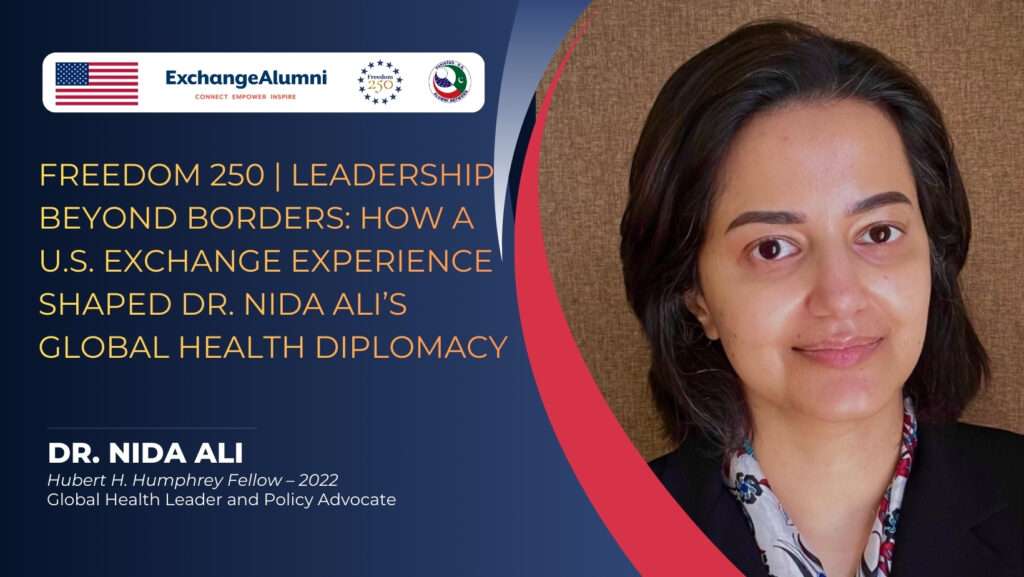
As part of the Freedom 250 Alumni Storytelling Campaign, the Pakistan–U.S. Alumni Network (PUAN) highlights alumni whose U.S. exchange experiences continue to shape leadership, innovation, and global collaboration. Dr. Nida Ali’s journey exemplifies how international exposure can transform technical expertise into global leadership.
Dr. Nida Ali, a 2021–22 Hubert H. Humphrey Fellow at Emory University, entered the fellowship with a strong foundation in medicine and epidemiology. Her Humphrey year, however, expanded her understanding of public health far beyond scientific programming and disease control. Immersed in one of the world’s most influential ecosystems for public health and diplomacy, including engagement with Emory University, the U.S. Centers for Disease Control and Prevention (CDC), The Task Force for Global Health, and a multinational cohort representing 12 countries, she began to see health challenges through the interconnected lenses of governance, equity, negotiation, and global cooperation.
The fellowship fundamentally reshaped her professional outlook. Exposure to policymaking environments and interagency coordination introduced her to systems thinking and diplomatic engagement, skills rarely taught in traditional medical training. Learning to negotiate across cultures, build consensus among diverse stakeholders, and translate evidence into policy became defining elements of her leadership approach.
A lasting professional affiliation with The Task Force for Global Health, established during her Humphrey Fellowship, further strengthened her engagement with U.S.-led global health partnerships. Through this collaboration, Dr. Ali gained firsthand experience in coalition-building, evidence-informed advocacy, and cross-border institutional partnerships, principles that continue to guide her work today.
Currently contributing to global advocacy efforts with the Coalition for Global Hepatitis Elimination, Dr. Ali works at the intersection of science and diplomacy. Her role involves engaging Permanent Missions at the United Nations in New York and Geneva, ministries of health across regions, and multilateral partners to elevate viral hepatitis elimination on global political agendas. In a field where no established diplomatic roadmap previously existed, she has helped advance dialogue and cooperation through negotiation, systems leadership, and sustained international engagement.
From frontline community health work during Pakistan’s polio outbreak response in Northern Khyber Pakhtunkhwa to high-level diplomatic negotiations at the United Nations, Dr. Ali’s journey reflects leadership informed by U.S. exchange experiences and strengthened through continued global collaboration.
As global health increasingly demands leaders who can bridge science, policy, and diplomacy, Dr. Ali encourages emerging Pakistani researchers and policy professionals to pursue U.S. exchange opportunities such as the Humphrey Fellowship. These programs, she emphasizes, go beyond academic enrichment, they cultivate collaborative leadership, global perspective, and the confidence to represent Pakistan in international decision-making spaces.
Her story reinforces a central message of Freedom 250: sustained Pakistan–U.S. exchange programs continue to empower professionals who contribute not only to national progress but also to solutions addressing shared global challenges.