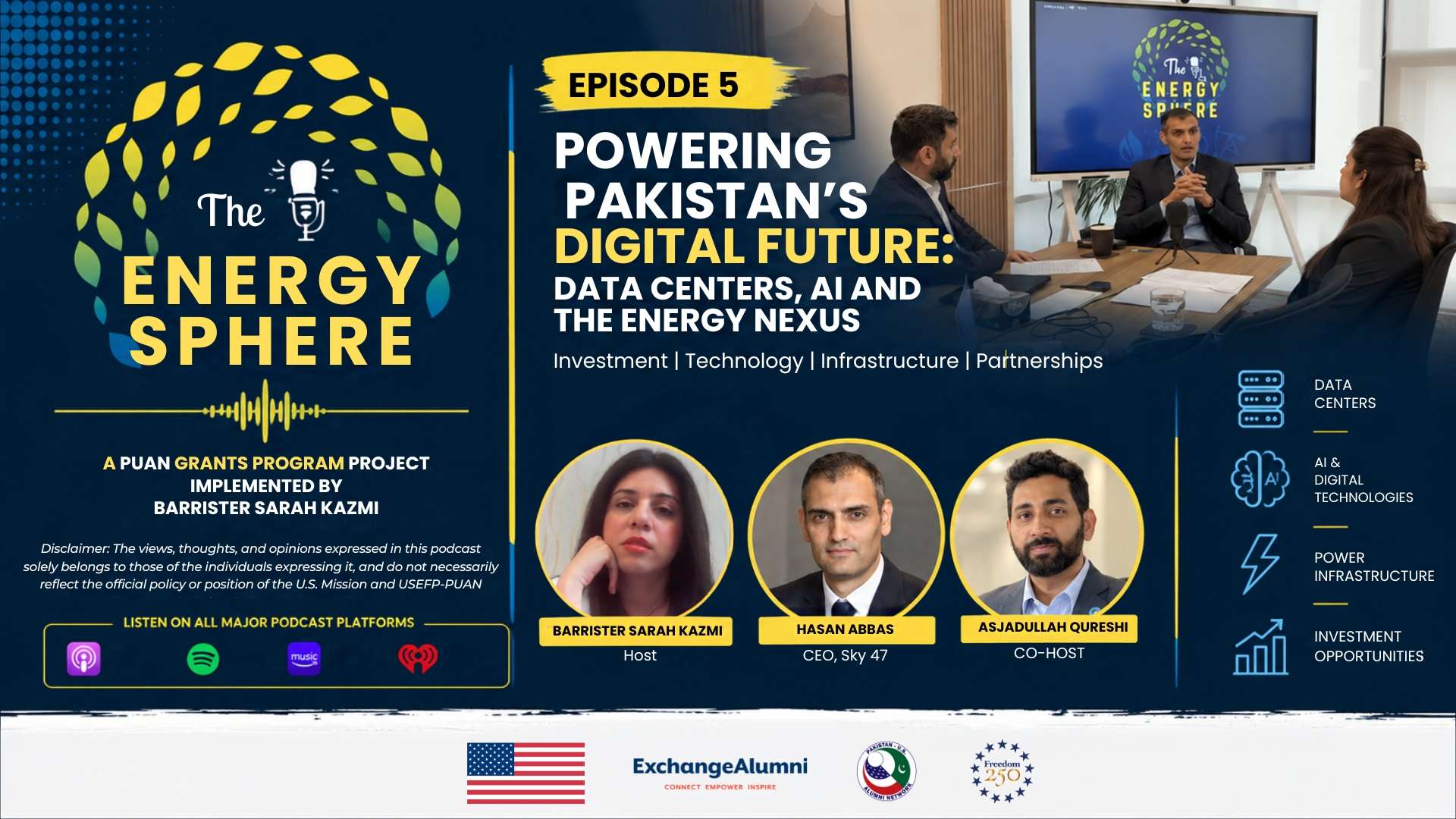
The fifth and final episode of The Energy Sphere under the PUAN Grants Program explores the growing intersection of energy and digital infrastructure, examining how data centers, artificial intelligence, cloud services and expanding computing requirements could create new opportunities for technology and investment in Pakistan.
As artificial intelligence, cloud computing and digital services expand, the physical infrastructure powering them is becoming increasingly important. Data centers sit at the center of this transformation, connecting computing capacity with electricity, connectivity, software and investment.
These connections are the focus of the fifth and final episode of The Energy Sphere podcast series implemented under the PUAN Grants Program. Led by IVLP 2025 alumna Barrister Sarah Kazmi, the series grew from an idea developed during a U.S. exchange experience into five conversations examining opportunities across Pakistan’s energy, technology and investment landscape.
In Episode 5, Barrister Sarah Kazmi and her co-host speak with Hasan Abbas, CEO of Sky 47, about Pakistan’s emerging data-center industry, the growing power requirements associated with AI, data residency, investment opportunities, digital infrastructure and the policies that could support future growth.
Where Energy Meets the Digital Economy
Data centers are often viewed primarily as information technology infrastructure, but their development is increasingly connected to the energy sector.
Modern data centers require significant and reliable electricity, with requirements varying according to the computing applications they support. As AI workloads expand, that connection becomes even stronger.
Abbas explained that this energy requirement was one of the reasons an energy company became involved in developing Sky 47. The company brings experience in power infrastructure into a business where reliable electricity is a fundamental operating requirement.
According to Abbas, Sky 47 has launched its first 8.5-megawatt campus and plans additional facilities in Karachi and Lahore. He said the company aims to add approximately 50 megawatts of data-center capacity in the coming years.
Its plans also extend beyond physical data-center space. Abbas described an ambition to offer services across the technology stack, including cloud infrastructure, AI capabilities and software-based services.
The result is an emerging business model in which energy infrastructure enables digital infrastructure, while digital growth creates new demand for energy investment and technology.
Building the Infrastructure Behind AI
Artificial intelligence is rapidly increasing the importance of computing infrastructure.
Abbas emphasized that AI extends beyond consumer-facing generative AI applications. He pointed to potential industrial uses in areas such as automation, manufacturing processes and quality control.
These applications require computing capacity at scale.
As businesses increasingly adopt AI, demand could therefore grow not only for software and computing hardware but also for the physical infrastructure required to operate them—including data centers, high-performance computing systems, connectivity and reliable power.
For Pakistan, this could create opportunities across multiple sectors. Companies developing data centers require power infrastructure, computing equipment, connectivity, cooling technologies, cloud services, cybersecurity capabilities, software and specialized technical expertise.
The growth of AI could consequently create an expanding commercial ecosystem connecting Pakistan’s energy and technology sectors.
Planning Power Infrastructure for Digital Growth
One of the central themes of Episode 5 is the relationship between Pakistan’s future digital economy and its electricity requirements.
Abbas noted that Pakistan has electricity-generation capacity available in different parts of the country, while mechanisms for delivering that electricity to major users continue to develop. He highlighted electricity wheeling as one potential mechanism for connecting available generation with large commercial consumers such as data centers.
For the immediate and near term, Abbas believes existing capacity can support data-center development. However, he expects the equation to change as Pakistan moves toward larger-scale AI infrastructure.
AI-oriented data centers can require substantially greater amounts of electricity than conventional facilities. Abbas therefore emphasized the importance of planning ahead for future computing and power requirements.
One approach discussed during the episode is identifying areas where data centers can be developed alongside adequate power infrastructure.
Such planning could help create a clearer pathway for future investment by aligning digital infrastructure development with electricity availability, grid connectivity and commercial power arrangements.
Data Centers as a New Investment Opportunity
The expansion of Pakistan’s digital economy could also create opportunities for investors looking beyond traditional technology businesses.
Developing a large-scale data center requires substantial capital and a combination of infrastructure, technology and operational expertise.
Abbas identified several factors investors consider when selecting locations, including reliable electricity, power costs and connectivity.
Pakistan’s domestic market could also generate demand for additional digital infrastructure as more businesses and consumers use digital services.
For investors, this means the opportunity is not limited to constructing data centers themselves. The wider value chain can include cloud services, connectivity, computing hardware, AI infrastructure, power solutions, software, cybersecurity and specialized professional services.
Abbas encouraged international technology companies and large cloud providers to examine Pakistan’s developing market as they assess future investment opportunities.
From Data Centers to AI Infrastructure
The scale and type of infrastructure required also change as data centers begin supporting advanced AI applications.
Traditional computing workloads can operate across smaller facilities, while large-scale AI applications increasingly rely on concentrated computing capacity, including high-performance processors and specialized infrastructure.
Abbas said Sky 47 is already receiving inquiries related to deploying GPUs for different applications and expects AI-related demand to increase.
He also highlighted liquid cooling as one example of the specialized infrastructure required for advanced AI workloads, noting that Sky 47 is offering this capability in Pakistan.
This illustrates how the next phase of data-center investment could increasingly involve technologies specifically designed for high-density computing and AI.
For Pakistan’s technology sector, this could create opportunities for companies working across hardware, software, infrastructure management and specialized technical services.
Expanding Pakistan’s Domestic Digital Infrastructure
Episode 5 also examines the growing importance of data residency and locally hosted cloud infrastructure.
As governments, businesses and consumers generate increasing amounts of digital information, decisions about where that information is stored and processed are becoming more important.
Abbas argued that expanding Pakistan’s domestic data-center capacity could allow more data and digital services to be hosted within the country’s jurisdiction.
He emphasized that locally hosted infrastructure can incorporate established security measures, including encryption and other technical protections.
From a commercial perspective, greater domestic hosting capacity could create opportunities for Pakistani and international companies providing cloud infrastructure, cybersecurity, data management and enterprise technology services.
It could also help develop a larger domestic market for the technical expertise required to operate sophisticated digital infrastructure.
Policy and Regulation as Enablers of Investment
Technology often develops faster than the regulatory frameworks surrounding it, a challenge faced by markets around the world.
During the discussion, Abbas pointed to regulatory developments in the United States and Europe as examples of governments adapting frameworks as new technologies emerge.
He also highlighted recent developments in Pakistan, including the Digital Nation Pakistan Act 2025, as steps toward developing a framework for the country’s digital transformation.
For investors entering a capital-intensive sector such as data centers, regulatory clarity can be particularly important.
Abbas noted that streamlined processes could make it easier for investors unfamiliar with Pakistan to navigate the market. He also pointed to increasing coordination between institutions responsible for technology and power as a positive development for a sector that sits directly between the two.
A clearer investment framework could therefore help connect policy, electricity infrastructure, technology and private capital as Pakistan’s data-center market develops.
From Islamabad to Karachi and Lahore
Sky 47’s expansion plans provide one example of how the sector could develop.
Following the launch of its Islamabad facility, Abbas said the company is working toward a facility in Karachi, with groundwork already underway. According to him, the company aims for the Karachi facility to become operational by the end of 2027, followed by expansion into Lahore.
Large facilities require significant planning and construction time, meaning investment decisions made today can shape the infrastructure available several years later.
The company is also pursuing technical certifications for its facilities as operations develop.
This expansion illustrates how growth in digital services can translate into physical investment across cities, connecting construction, power, connectivity, computing infrastructure and specialized technology services.
Connecting Digital Infrastructure with Pakistan’s Power Sector
Episode 5 also explores the different ways data centers can secure the electricity they require.
Abbas explained that Sky 47 currently uses a combination of grid electricity and captive generation. The discussion also examined how evolving commercial power arrangements could provide additional options for large electricity users.
The important point for future investment is that data centers and energy infrastructure increasingly need to be planned together.
As computing density increases, particularly for AI workloads, electricity availability and reliability become central factors in determining where facilities can operate.
This creates potential opportunities not only for technology companies but also for businesses working in power infrastructure, electricity management, grid technologies and commercial energy solutions.
The same relationship works in the opposite direction: growth in digital infrastructure can create a new category of large commercial electricity customers, potentially opening additional opportunities for investment across the power sector.
Building an Ecosystem Around Data Centers
The conversation also raises the possibility of developing stronger industry coordination as Pakistan’s data-center sector grows.
Abbas discussed the value of creating a platform or industry body representing data-center operators and other stakeholders.
Such a mechanism could provide a structured channel for industry participants to engage on technical standards, infrastructure requirements, investment considerations and sector development.
As Pakistan’s data-center market expands, this type of coordination could become increasingly useful because the sector operates across multiple areas, including technology, telecommunications, electricity, investment and digital services.
Bringing these areas together could help businesses and relevant institutions better understand the requirements of a rapidly developing industry.
Pakistan’s Domestic Market as a Driver of Growth
While international investment is an important part of the discussion, Episode 5 also highlights Pakistan’s domestic market as a potential driver of data-center demand.
As more economic activity becomes digitized, businesses require additional computing, storage, cloud and software services.
For Abbas, this means future demand for data centers will not depend exclusively on Pakistan becoming a regional hosting destination. Growth within Pakistan itself could require substantial additional infrastructure.
This distinction is important for investors.
Pakistan’s opportunity is not solely based on exporting digital infrastructure services. A growing domestic market could itself support investment in data centers, cloud platforms, AI infrastructure and related technology services.
As digital adoption expands, the infrastructure supporting those services will need to expand alongside it.
Creating Opportunities for International Technology Partnerships
The development of data centers and AI infrastructure could also create new areas for international business-to-business partnerships.
Large global technology and cloud companies bring expertise in areas including advanced computing, cloud architecture, AI hardware, data-center technologies and digital services.
Pakistani companies, meanwhile, can contribute local market knowledge, infrastructure, technical talent and an understanding of domestic operating requirements.
Abbas suggested that major international cloud and technology providers should examine Pakistan’s developing market as they assess future investment opportunities.
For U.S.–Pakistan trade and investment relations, the broader sector could provide potential opportunities in cloud computing, AI infrastructure, specialized hardware, cybersecurity, software, data-center technologies and related professional services.
These opportunities would build on commercial requirements generated by Pakistan’s expanding digital economy rather than relying on a single technology or investment model.
Energy as the Foundation of the Digital Economy
Perhaps the clearest takeaway from Episode 5 is that the distinction between the energy economy and the digital economy is becoming increasingly blurred.
Data centers turn electricity into computing capacity. AI increases that computing requirement further. As digital services expand, the infrastructure supporting them must expand as well.
That creates a connected chain of commercial activity:
Power Infrastructure → Data Centers → Cloud and Computing Capacity → AI and Digital Services → Business Growth and Investment
For Pakistan, developing this chain could create opportunities across sectors that have traditionally been considered separately.
Energy companies may find new commercial customers in digital infrastructure. Technology companies may increasingly need expertise in power. Investors may need to evaluate electricity and computing infrastructure together.
This energy–technology nexus could become increasingly important as Pakistan’s digital economy develops.
From a U.S. Exchange Experience to a Five-Episode Energy Conversation
The Energy Sphere began with an idea developed during the hosts’ participation in the 2025 International Visitor Leadership Program (IVLP) on Integrated Energy Planning for the Power and Petroleum Sectors in Pakistan. Through the PUAN Grants Program, IVLP 2025 alumna Barrister Sarah Kazmi and her team developed that idea into a five-episode podcast series examining emerging opportunities across Pakistan’s energy and technology sectors.
Across the series, the conversations moved from the origins of The Energy Sphere to increasingly specialized areas of policy, investment and technology. Episode 1 introduced the podcast and the U.S. exchange experience that inspired it. Episode 2, featuring former PPIB Managing Director Shah Jahan Mirza, examined private investment, power-sector reforms, grid modernization and opportunities in Pakistan’s electricity sector. Episode 3, with Dan Acker, Economic Officer at the U.S. Embassy in Islamabad, explored opportunities for U.S.–Pakistan trade and investment in energy and minerals, including critical minerals, technology, financing and commercial partnerships. Episode 4, featuring Dr. Naveed Arshad, Director of the LUMS Energy Institute, turned to Pakistan’s growing electric vehicle market and opportunities across batteries, charging infrastructure, software, manufacturing and technology partnerships.
Episode 1
Episode 2
Episode 3
Episode 4
The fifth and final episode extends that conversation into the infrastructure supporting the digital economy. With Hasan Abbas, CEO of Sky 47, the discussion examines how data centers, AI, cloud services and growing computing requirements are creating new connections between Pakistan’s energy and technology sectors.
Taken together, the five episodes connect energy policy, private investment, U.S.–Pakistan commercial opportunities, electric mobility, digital infrastructure and emerging technologies. Through conversations with energy-sector professionals, the series has examined practical opportunities for investment, technology deployment, business development and commercial partnerships across Pakistan’s evolving energy landscape.
What began as an idea during a U.S. exchange experience has developed, through the PUAN Grants Program, into a five-episode professional conversation connecting exchange learning with issues and opportunities relevant to Pakistan’s energy and technology sectors.
The Energy Sphere is implemented by IVLP 2025 alumna Barrister Sarah Kazmi under the PUAN Grants Program, with support from the U.S. Mission to Pakistan through the Pakistan-U.S. Alumni Network (PUAN).