For Lahore-based storyteller and media practitioner Hammad Anwar, stories are not just creative tools, they are survival skills. With more than a decade of experience working across comic books, animated videos, documentaries, and podcasts, Hammad has long believed that the most complex ideas can be understood when they are told well.
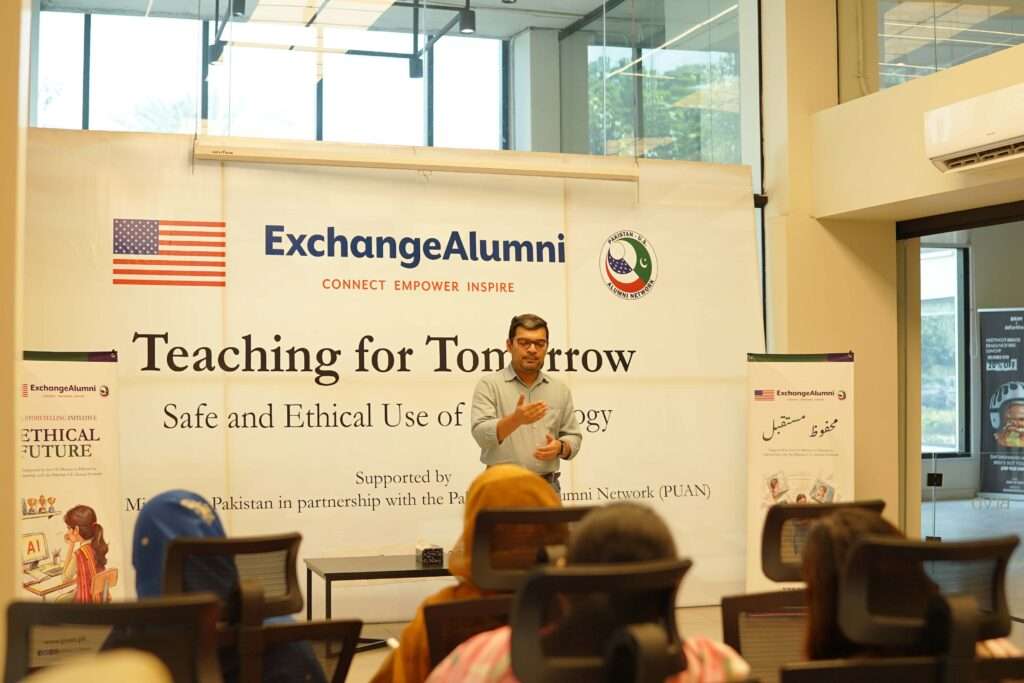
That belief came to life through “Ethical Futures: A Storytelling Initiative for Responsible Tech Use Among Youth,” a PUAN Grants project that used narrative-driven learning to strengthen digital literacy and technology ethics among young people aged 13 to 20.
A graduate of the International Visitor Leadership Program (IVLP), 2014, Hammad designed the project to move away from traditional lectures and instead engage students through stories, relatable, engaging, and rooted in real digital experiences. Implemented over 20 weeks, the project reached 20 direct beneficiaries through intensive engagement, while extending its impact to over 500 indirect beneficiaries and far beyond through digital platforms.
Learning Ethics Through Stories
The Ethical Futures project focused on helping students and educators better understand responsible technology use, ethical AI practices, and online safety. To do this, Hammad and his team developed a suite of creative resources, including:
- An original bilingual storybook
- Urdu audiobooks
- A teacher training manual
- A short documentary capturing the project journey
All materials were published under Creative Commons, ensuring open and long-term access.
The project unfolded in three phases: content development, classroom storytelling sessions, and teacher training. Trained facilitators delivered 10 narrative-based sessions across 8 schools, 1 college, and 1 university, engaging more than 840 students. This was followed by a full-day workshop for 23 teachers, equipping them with storytelling tools to teach digital ethics in their own classrooms.
Voices From the Classroom
For many students, the experience felt refreshingly different.
“The way our trainer taught us felt more like a conversation than a lecture about secure browsing,” said Maheen Rizwan, 14, from Lahore. “He communicated in a very friendly way how to keep ourselves safe.”
Another participant, Rahma, 19, reflected on the creative empowerment the project encouraged:
“As students of a creative field, the least we can do is think for ourselves and produce our own work.”
Impact Beyond Expectations
While the project prioritized meaningful engagement over large numbers, its digital reach exceeded expectations. The audiobooks and multimedia content significantly outperformed similar existing videos, validating the power of storytelling as an educational medium. In total, the project’s online components reached more than 120,000 people, expanding its influence well beyond classroom walls.
Reflecting on the experience, Hammad shares that the project reinforced an important lesson: when young people are respected as thinkers and engaged through stories, they respond with curiosity, insight, and responsibility.
A Collaborative Effort
Hammad credits the success of Ethical Futures to the strong support from the U.S. Mission and the Pakistan-U.S. Alumni Network (PUAN).
“The collaboration was extremely positive and supportive,” he noted. “The PUAN team’s guidance, feedback, and encouragement played a key role in keeping the project on track and strengthening its long-term value.”
Looking Ahead
With audiobooks hosted on YouTube and all content available as open-source material, Ethical Futures is designed to keep growing even after the grant period. The project’s storytelling resources continue to be shared, downloaded, and adapted, ensuring that conversations around digital ethics remain accessible, relevant, and ongoing.
For Hammad Anwar, this project is not an endpoint, but a continuation of a lifelong commitment: using stories to challenge narratives, spark dialogue, and help young people navigate an increasingly complex digital world, ethically, creatively, and responsibly.